
You secure more work when you include clear, itemized costs and a professional breakdown to help you write a plumbing estimate that wins jobs. For more insights, check out What Is a Good Net Profit Margin For a Plumbing Company?.
Two factors change how you structure these documents: the scale of the project and the type of client. Commercial clients often require formal, detailed line items, while residential homeowners prioritize clear communication about labor and materials. For more insights, check out How Can I Manage Plumbing Employees Effectively?.
Write estimates that win the right clients
You need to know who you’re sending your estimate to before you put pen to paper. A homeowner often cares most about the final price and when you can start the job. They want to know you’re reliable and that you won’t leave a mess. If you use technical jargon about pipe grades or fitting standards, they may feel confused rather than confident. For more insights, check out How to Get More Plumbing Customers Online?.
Commercial property managers or contractors, however, look for specifics. They need to see that you understand the project scope, the safety standards, and the timeline. They might require a bid that lists specific parts, hours of labor, and waste removal costs separately. If you don’t provide this level of detail, they will likely choose a competitor who does.
This page serves the independent plumbing professional who wants to grow their business through better client communication. We assume you already have the technical skills to do the work; here, we focus on the administrative side of the trade. If you’re looking for advice on how to price your labor or calculate your overhead, you should consult business resources specifically for trade contractors.
Factors that influence your success
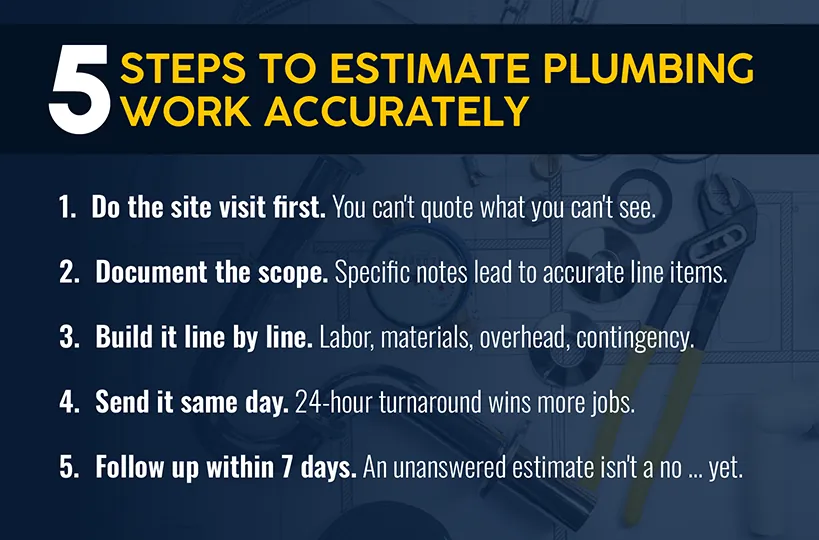
The accuracy of your site visit is the most important factor in winning a job. If you guess the cost of materials without seeing the actual space, you’ll either overcharge and lose the bid or undercharge and lose money. Always measure the pipe runs and check for hidden issues like rust or tight access points before you write a single line.
The speed of your response matters almost as much as the price. A customer who has a leaking pipe or a broken water heater wants a solution now. If you wait 48 hours to send your estimate, they will have already called someone else. Send a professional summary within 24 hours of your visit whenever possible.
Clear communication about your warranty and insurance coverage builds trust. Clients are often worried about liability if a pipe bursts after you leave. When you state your work guarantee in writing, you remove a major barrier to hiring you.
The way you present the final document is the detail most people get wrong. A handwritten note on a scrap of paper looks unprofessional and suggests you aren’t organized. Use a clean, digital format that includes your company logo, contact details, and a clear “Valid Until” date for the pricing.
Building a professional estimate
- Start with a header that includes your company name, address, and license number.
- List the customer’s name, the service address, and the date of the estimate.
- Write a brief “Scope of Work” paragraph that describes exactly what you plan to do.
- Create a table for materials, listing the quantity, description, and unit price for each item.
- Add a separate line for labor hours and your hourly rate so the client sees the value of your time.
- Include any permit fees or equipment rental costs, such as drain cleaning machines, as separate line items.
- State the total cost clearly at the bottom in bold text.
- Add your payment terms, such as “50% deposit required to start work,” so there’s no confusion later.
- List your warranty terms, such as “One-year warranty on all installed parts and labor.”
- End with a space for the client to sign and date their approval.
The judgement call that separates a winning estimate from a failed one is the “Next Steps” section. Don’t just list the price; tell the customer how to proceed. A simple line like “To schedule this work, please sign below or call us at [Phone Number]” makes it easy for them to say yes.
Comparison of project estimates
| Situation | Primary focus | What to include | What to watch for |
|---|---|---|---|
| Emergency repair | Speed and access | Clear labor rates | Hidden pipe damage |
| Bathroom remodel | Material quality | Itemized fixture costs | Changing floor plans |
| Commercial bid | Safety compliance | Detailed part specs | Strict project deadlines |
| Routine maintenance | Annual cost | Recurring service plan | Future system upgrades |
When evaluating emergency repair estimates, prioritize the mobilization fee over the total quote. If a contractor charges a flat trip fee rather than an hourly rate, you risk paying for idle time. Always verify if the estimate covers exploratory demolition, as hidden water damage often triples the final invoice.
For bathroom remodels, watch the “allowance” line items. Contractors often list low-cost fixtures to keep the initial bid attractive. Changing your floor plan mid-project adds structural labor that’s rarely included in base bids.
Commercial bids require a deep dive into safety compliance documentation. If the estimate fails to explicitly list insurance riders or OSHA certification costs, you could be held liable for workplace accidents. Check the fine print for liquidated damages clauses. These penalties trigger if you miss a strict project deadline, often costing you thousands per day of delay.
Routine maintenance bids should be judged on the long-term service contract rather than the first visit. If an estimate covers only the current repair, you lose money on future service calls. A strong bid includes a multi-year plan that factors in system upgrades. If the provider can’t explain how they track your equipment’s lifespan, they’re likely just performing reactive fixes. Use this decision rule: if the estimate lacks a multi-year parts warranty, treat it as a temporary patch rather than a comprehensive maintenance solution.
Details that build professional trust
The importance of site preparation
Experienced plumbers always document existing conditions before starting. If you see pre-existing damage near the work area, take a photo and mention it in the estimate. This protects you from being blamed for problems you didn’t cause. Beginners often skip this, which leads to disputes and lost profit later.
Managing client expectations
A good estimate explains why you chose specific materials. If you use high-grade copper or specific PEX tubing, mention why that’s better for their home. This justifies your price against cheaper competitors. According to the Environmental Protection Agency, fixing simple leaks can save homeowners about 10% on their water bills, so highlighting quality materials helps the client see the long-term value.
Troubleshooting your estimate process
| What you notice | What it means | What to do first | How to stop it |
|---|---|---|---|
| Customer is silent | Price feels high | Explain your quality | Itemize labor vs parts |
| Client asks for discount | Budget is limited | Offer cheaper parts | Show value in writing |
| Job scope changes | Poor initial plan | Update the bid | Confirm scope in email |
| Payment is delayed | Terms are unclear | Require a deposit | Sign a formal contract |
When a client goes silent after receiving a quote, they’re likely suffering from sticker shock. Don’t lower your price immediately. Instead, break down the estimate into specific labor hours and material costs. This transparency justifies your expertise and separates the cost of professional skill from the raw expense of parts.
If a client asks for a discount, they’re signaling a hard budget cap. If you have room to maneuver, offer a “good, better, best” tiering system. This allows the client to choose a lower-cost alternative without you devaluing your primary service. If you can’t lower the price, provide a written breakdown of the long-term maintenance costs they avoid by choosing your higher-quality materials today.
Scope creep is the most common profit killer in contracting. It usually happens because the initial discovery phase was too brief. If a client adds tasks mid-project, stop work immediately. Issue a formal change order that outlines the new cost and the revised completion date. Never accept verbal additions; if it isn’t in an email, it doesn’t exist.
Finally, delayed payments often stem from vague invoicing. Always attach a signed contract that defines the payment schedule, the grace period, and the specific penalties for late fees. If a client refuses to sign a contract, walk away. The cost of a bad client always exceeds the profit of a single job.
Rules that govern your work
You must comply with local building codes, which are often enforced by your city or county building department. These codes dictate what materials you can use and how you must install them. If your estimate doesn’t account for the labor needed to meet these standards, you’ll be forced to choose between breaking the law or losing money on the project. Always check your local jurisdiction’s website to ensure your methods meet the current plumbing code requirements. If a job requires a permit, it’s your responsibility to include that cost in your estimate; failing to do so is a common mistake that can lead to fines or the rejection of your work by an inspector.
Managing your business costs
The cost of your estimate isn’t just the time you spend typing; it’s the time you spend driving to the site and evaluating the problem. If you offer free estimates, you must build the cost of your travel and assessment into your hourly rate for the jobs you actually win.
Calculate your “cost of acquisition” by tracking every hour spent on non-billable site visits over a single month. Divide that total by the number of jobs you successfully booked in that same period.
If you charge for estimates, make sure the client knows that this fee will be deducted from the final invoice if they hire you. This prevents tire-kickers from wasting your day while keeping serious customers happy.
Use this simple decision rule: if the site visit requires more than 30 minutes of travel one-way, charge a flat “consultation fee” upfront. If the client is within a 10-mile radius, offer the estimate for free.
The biggest mistake is failing to account for the “hidden” overhead of follow-up emails and material research. Many contractors treat these as favors, but they’re actually labor costs. If you don’t track these minutes, you’re essentially paying your clients for the privilege of working for them.
Always provide a clear breakdown of these costs in your initial proposal. Transparency builds trust, while hidden fees often lead to disputes during the final billing phase. When a client sees the value of your time, they’re far more likely to respect your professional boundaries.
Keeping your client relationship healthy
After the work is finished, keep a copy of the estimate in your digital files. If the client calls you a year later with a question, you can quickly pull up exactly what was installed and when.
Organize these records by the client’s address rather than their name. People often forget the specific service date, but they always know where they live. This simple indexing shift saves you minutes of searching during a high-pressure troubleshooting call.
If you notice a part is nearing the end of its life, send a follow-up email to remind them. Base this timeline on the manufacturer’s suggested service interval, not your own intuition. Consult the owner’s manual to determine the appropriate timing based on usage, and set a calendar alert accordingly.
The common mistake is waiting for the client to experience a failure before you reach out. This forces the client to view your contact as an emergency repair bill rather than a preventative benefit.
If the cost is lower, focus on the repair. By framing your outreach as a way to avoid a total system shutdown, you shift your role from a vendor to a trusted advisor. This proactive service turns a one-time customer into a repeat client who trusts your judgment.
When to decline a project
Sometimes the best way to grow is to walk away. If a potential client asks you to cut corners on safety or use unapproved materials, refuse the job immediately. You can’t risk your license or your reputation for a single paycheck.
The most common mistake is accepting “scope creep” projects that fall just outside your core competency. If a job requires a specialized permit you don’t hold, or if the project timeline requires you to bypass standard inspection phases, the cost of a single failure will far exceed the profit margin of the contract.
Use this simple decision rule to protect your business: if the client’s request forces you to deviate from your standard operating procedure or requires equipment you don’t own, decline. If you can perform the work safely but lack the specific expertise, refer the client to a trusted specialist.
Honesty about your limits builds more respect than a bad job ever could. Clients often view a refusal based on safety as a sign of integrity rather than incompetence.
Ask yourself if you would be proud to showcase this job in your portfolio three years from now. If the answer is no because of the quality of materials or the shortcuts required, the project is a liability. You aren’t just turning down a paycheck; you’re protecting your future capacity to bid on higher-quality work. When you stop chasing every lead, you gain the time to pursue the projects that actually build your brand.
Frequently asked questions
How long should I make my estimate valid for?
Most professional estimates are valid for 14 to 30 days. This protects you from price changes in materials, which can fluctuate frequently. Always state the expiration date clearly at the bottom of your document so the client knows their quote isn’t an offer that stays open forever.
Should I list labor and materials separately?
Yes, you should always list them separately to show the client where their money is going. This transparency helps customers understand that your price covers both your expertise and the cost of quality parts, making your total bid seem more reasonable than an all-in-one number.
What happens if I find more damage during the job?
You must stop work and provide a change order for the client to approve. Never proceed with extra repairs without written consent, as this is the most common cause of payment disputes in the plumbing trade. Always explain the new issue and the cost to fix it clearly.
Is it safe to send estimates by email?
It’s safe and expected, provided you use a professional PDF format. Don’t send estimates in the body of an email, as the formatting can break and look unprofessional on a phone. A PDF ensures your document looks exactly the same on any device the client uses.
Does it matter if I use a software tool?
It matters because it saves you time and ensures your branding stays consistent. While you can use a basic spreadsheet, professional invoicing software helps you track whether a client has opened your quote. This data helps you decide when to follow up and saves you from guessing.
How do I handle a customer who wants a lower price?
You should explain the specific quality of the parts or the safety standards you’re following. Never simply lower your price, as this suggests your first quote was inflated. If they still want to pay less, offer to remove non-essential items or use less expensive materials.
Conclusion
Start your estimate process by confirming the exact scope of the problem during your site visit. A well-written bid provides the client with the confidence to choose you over a cheaper competitor. If you notice signs of structural damage or issues that fall outside your expertise, stop and call a specialist immediately to protect your client and your professional reputation.