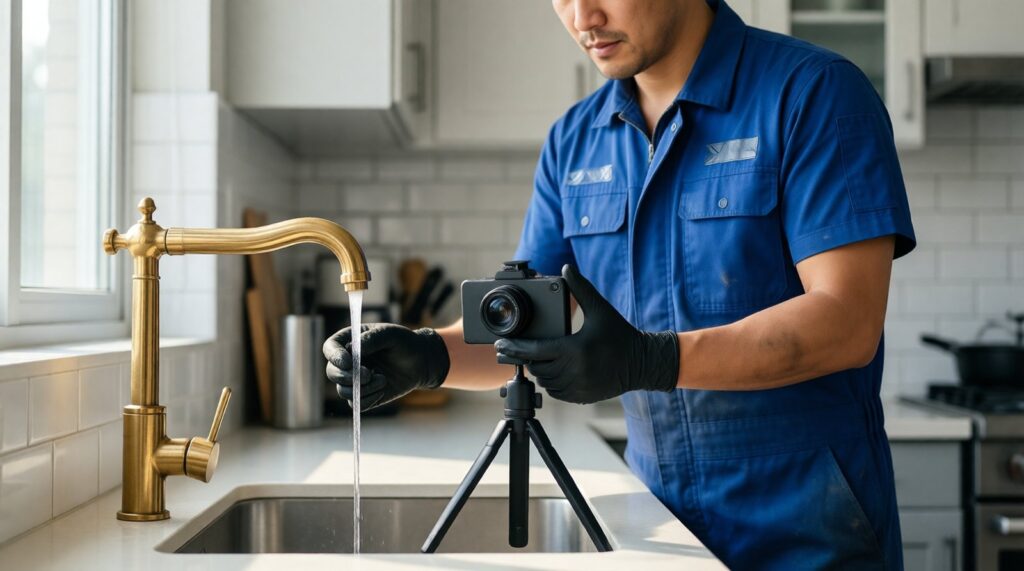
You use AI for local plumbing SEO by generating location-specific service pages, optimizing Google Business Profile posts, and drafting review responses that include your city and services without keyword stuffing. For more insights, check out What is a Street Fitting in Plumbing.
Your actual results depend on three things: how well you verify AI output against real plumbing codes and service areas, whether you add unique job-site photos to AI-generated content, and your current domain authority relative to competitors in your metro area. These variables determine if AI accelerates your rankings or produces generic pages that stall at page two. For more insights, check out Top 10 Plumbing Tools and Their Uses.
Who should use AI for local plumbing SEO
This page serves established plumbing companies with 3+ years of local reviews who want to scale content production without hiring a full-time writer. You already have verified service data, real customer feedback, and a functional website but lack the bandwidth to publish weekly location pages or blog posts targeting neighborhood-specific queries like “water heater repair in [suburb].”
It doesn’t serve new plumbing businesses with fewer than 20 reviews or no verified service history. If you’re still building trust signals, AI-generated content will highlight your thin profile rather than strengthen it; focus first on completing jobs, collecting genuine reviews, and verifying your Google Business Profile categories before automating content. The assumption here is that you have real plumbing expertise to validate AI output, not that AI can substitute for field experience. For more insights, check out What to Know Before Starting a Plumbing Business (2026).
Contractors managing multiple metro areas also benefit differently than single-city operators. Multi-location firms need AI to maintain consistent messaging across 10+ suburb pages while avoiding duplicate content issues, whereas solo plumbers may only need help with seasonal maintenance articles. If you operate in one town under 50,000 population, manual writing often outperforms AI because hyperlocal nuance matters more than volume. Check your Google Search Console impressions for “[service] + [neighborhood]” queries to confirm whether scaling content justifies the tool cost.
Factors that change your results
Local search intent alignment matters most and gets wrong most often. AI defaults to national-level advice unless prompted with specific neighborhood names, zip codes, and local code references. Pages targeting “drain cleaning” generically won’t rank against competitors mentioning “cast iron pipe descaling in pre-war homes” or referencing municipal backflow testing requirements. Verify every AI draft against your actual service records and city permitting office guidelines before publishing.
Review velocity and sentiment shape what AI should emphasize. Businesses with 100+ reviews averaging 4.5 stars can safely automate review response templates incorporating service keywords, while those below 4.0 stars risk amplifying complaints through tone-deaf automation. Calculate your average monthly new reviews over six months; if it’s under five, prioritize earning real feedback before deploying response generators. Your Google Business Profile insights show which services drive clicks—feed this data into prompts instead of guessing.
Existing site architecture determines AI’s leverage point. Sites with clean service-area hierarchies convert AI content faster than flat structures where all pages compete internally. Audit your URL structure first; if location pages live under /services/ instead of /[city]/, reorganize before generating new content. Sites with lower third-party authority metrics may need heavier internal linking and schema markup to gain traction, while established sites often see indexing faster. Check your metric via Moz or Ahrefs free tools to set realistic timelines.
Content verification capacity is the hidden bottleneck. Every AI-generated plumbing article requires fact-checking against IPC codes, manufacturer specifications, and local ordinances. Budget two hours per published piece for technical review if you lack dedicated staff; skipping this step produces inaccurate advice that damages E-E-A-T signals and invites negative reviews from customers who followed bad guidance.
Plumbing SEO workflow using AI
- Export your top 20 converting search queries from Google Business Profile and Search Console, filtering for location-modified terms like “emergency plumber near downtown” or “tankless water heater installation [suburb],” then paste them into your AI tool as seed keywords to generate topic clusters aligned with actual demand rather than guessed intent.
- Build a master prompt template specifying your company name, primary service area boundaries, state plumbing license number, and three recent job examples with before/after details; this anchors every generation in verifiable facts and prevents hallucinated credentials or service zones you don’t actually cover.
- Generate location-specific service page drafts one suburb at a time, requiring the AI to reference at least two local landmarks, one municipal code section relevant to that jurisdiction, and one seasonal consideration tied to regional weather patterns; reject any output lacking these concrete local anchors.
- Cross-reference every technical claim against the International Plumbing Code or your state’s adopted version, manufacturer installation manuals, and city inspector FAQs; correct inaccuracies inline and add citations linking to official sources, because unverified advice erodes trust and violates YMYL standards for home services.
- Insert original job-site photos showing actual work performed in that specific neighborhood, captioned with street names or subdivision references when permissible; stock images or AI-generated visuals fail local relevance tests and reduce click-through rates compared to authentic documentation of completed projects.
- Create FAQ sections answering questions pulled directly from your phone logs, voicemail transcripts, and review comments rather than AI-suggested queries; real customer language matches voice search patterns better than polished alternatives and signals genuine expertise to both users and algorithms.
- Draft Google Business Profile updates highlighting completed jobs, community involvement, or seasonal tips using AI to condense raw notes into 250-character posts; schedule these weekly to maintain freshness signals without daily manual effort, tracking engagement metrics to refine future topics.
- Generate review responses acknowledging specific services mentioned, referencing the reviewer’s neighborhood when appropriate, and inviting offline follow-up for unresolved issues; customize each template individually to avoid robotic repetition that platforms penalize and customers distrust.
The judgment separating effective implementation from spam is whether every AI-assisted page could withstand scrutiny from a local building inspector or skeptical homeowner. If removing the AI layer leaves hollow content, the tool amplified weakness instead of strengthening expertise. Stop automating until your underlying service delivery and documentation practices produce substance worth scaling. For complex code interpretations or liability-sensitive advice, consult a licensed master plumber or legal professional rather than relying solely on language models.
Content types and effort comparison
Different plumbing SEO tasks yield varying returns when assisted by AI, depending on your existing assets and market saturation.
| Situation | What to do | Real cost | Watch for |
|---|---|---|---|
| New suburb pages | Generate drafts with local code refs | 3 hours verification each | Duplicate content across locations |
| Review responses | Template then customize individually | 15 minutes per batch | Robotic tone triggering flags |
| Seasonal maintenance blogs | Outline from past service calls | 2 hours editing plus photos | Generic advice ignoring regional climate |
| Service category expansions | Research competitor gaps via AI | 4 hours technical validation | Overpromising capabilities you lack |
| GBP post scheduling | Condense job notes to 250 chars | 30 minutes weekly planning | Stale content during slow seasons |
| Schema markup generation | Feed service data to structured data tools | 1 hour testing per page | Invalid JSON breaking rich results |
| Competitor backlink analysis | Identify local citation opportunities | 2 hours outreach prep | Low-quality directories hurting authority |
Effort estimates assume moderate AI familiarity and access to verified business data. Without organized service records or photo archives, double the preparation time before generation begins. Markets with 50+ competing plumbers require deeper localization than rural areas with three providers; adjust verification depth accordingly based on your SERP competition analysis.
Getting plumbing SEO right
Verifying technical accuracy
Every AI-generated plumbing claim must pass a three-source test before publication: manufacturer specification sheet, applicable code section, and at least one completed job record matching the described scenario. AI frequently conflates similar products or misstates pressure ratings, flow requirements, and compatibility constraints that vary by model year and installation context.
Cross-check tankless water heater BTU calculations against Navien or Rinnai spec sheets rather than accepting rounded figures, and confirm venting distances against current IRC G2427 tables since older training data reflects superseded editions.
Document your verification process in an internal checklist reviewers complete before approving content. Note which claims required correction, what source resolved the discrepancy, and whether the error pattern recurs across multiple generations. This log becomes your prompt refinement roadmap, reducing future fact-checking time by teaching the model your specific equipment inventory and jurisdictional amendments. Skipping this step saves hours upfront but costs weeks when customers report failed installations based on outdated clearances or incompatible fittings recommended confidently by plausible-sounding text.
Maintaining local authenticity
Embed neighborhood-specific details that only someone serving that area would know: the year subdivisions were built, common pipe materials in different developments, recurring drainage issues tied to topography, and seasonal problems linked to microclimates within your metro.
AI can’t reliably distinguish between clay soil neighborhoods prone to root intrusion versus sandy areas with shifting foundation risks unless you supply that geographic intelligence explicitly in prompts. Reference actual intersections, school districts, or HOA names residents use when describing their location to search engines.
Balance automation with human voice by recording brief audio memos after notable jobs and transcribing them as source material for AI drafts. Phrases like “the old galvanized lines behind Elm Street always corrode at the union fitting” carry experiential weight no synthetic text replicates authentically. Readers detect generic content instantly through absence of tactile detail, and Google’s helpful content system increasingly rewards demonstrated firsthand knowledge over comprehensive-but-hollow coverage. Your competitive advantage lies in accumulated local pattern recognition, not word count.
Common plumbing SEO mistakes
These errors appear repeatedly when contractors adopt AI without adapting workflows to local service realities.
| What you notice | What it usually means | What to do first | How to stop it happening again |
|---|---|---|---|
| Rankings drop after publishing | Thin or duplicate content penalty | Audit new pages against existing ones | Require unique local anchors per page |
| High bounce rate on service pages | Generic advice mismatching intent | Add neighborhood-specific scenarios | Feed real job data into prompts |
| Negative reviews mention bad advice | Unverified technical claims published | Correct inaccuracies immediately publicly | Implement three-source verification checklist |
| GBP posts get zero engagement | Promotional tone without value | Rewrite focusing on problem-solving | Use customer question language exclusively |
| AI suggestions ignore your equipment | Prompt lacks inventory context | Upload current product catalog | Maintain updated master prompt template |
| Competitors outrank despite less content | Superior local relevance signals | Analyze their neighborhood references | Incorporate hyperlocal details they miss |
| Schema markup fails validation | Incorrect service type or area | Test via Rich Results Tool before deploy | Save validated templates per category |
Mistakes compound when treated as isolated fixes rather than systemic workflow gaps. Track error patterns monthly to identify whether failures stem from prompting, verification, or publishing stages. Addressing root causes prevents recurrence better than reactive corrections that consume escalating time as content volume grows.
Local search compliance rules
Google’s guidelines for local service businesses prohibit misrepresenting service areas, fabricating reviews, or creating doorway pages targeting locations you don’t physically serve. Violations trigger suspension regardless of content quality elsewhere.
FTC endorsement rules apply to AI-generated review responses and testimonial content. Disclose material connections when referencing affiliated suppliers or incentivized feedback, and never imply verified purchase status for hypothetical scenarios. State licensing boards additionally regulate advertising claims about specialties, warranties, and pricing; verify that AI-drafted promises align with your actual bond coverage and warranty terms before publication. Misstated guarantees constitute false advertising even when generated unintentionally.
Municipal advertising ordinances sometimes restrict comparative claims or emergency service representations. Check your city’s consumer protection division website for plumbing-specific marketing rules before automating promotional content. Where regulations conflict across jurisdictions within your service area, default to the strictest standard or create separate compliant versions per municipality. Legal review of AI-generated templates costs far less than defending misleading advertising complaints or license disciplinary actions stemming from automated oversights.
Real costs of AI SEO tools
Monthly expenses vary depending on tool tier and content volume, but true cost includes verification labor and opportunity cost of diverted technician time. Basic AI writers are inexpensive relative to the alternative for limited generations, while SEO-focused platforms with local ranking trackers and competitor analysis cost more for small business plans. Enterprise solutions rarely justify ROI for plumbing firms under $2M annual revenue.
Hidden costs accumulate through fact-checking hours, photo sourcing, and schema implementation that AI doesn’t handle autonomously. Budget 2-3 hours per published page for technical review and formatting if handling internally, or $75-$150 per page if outsourcing to specialized plumbing content editors familiar with trade terminology.
Cost efficiency improves dramatically when AI handles repetitive tasks like review responses and GBP posts rather than core service pages requiring deep expertise. Calculate your break-even point by comparing AI-assisted output value against equivalent freelance writer rates, which are inexpensive relative to the alternative for qualified trades writers, minus your verification overhead. If internal review consumes more than half the time saved, the tool isn’t configured properly for your workflow or your content needs exceed what automation should handle.
Maintaining AI-assisted content
Published AI content degrades without scheduled updates reflecting code changes, product discontinuations, and shifting neighborhood conditions. Set calendar reminders quarterly to audit top-performing pages against current manufacturer specs and municipal amendments, updating statistics, pricing ranges, and regulatory references that drift from reality over months. Outdated clearance distances or discontinued model numbers undermine credibility faster than any optimization gain compensates.
Monitor performance signals indicating content decay: declining organic traffic, rising bounce rates, increased “people also ask” queries your page no longer answers, and competitor pages overtaking yours for previously held positions. These metrics signal refresh needs more reliably than arbitrary schedules, especially in markets experiencing rapid development or regulatory overhaul. Update underperforming pages before creating new ones to preserve existing equity.
Archive or redirect pages covering obsolete services, withdrawn products, or annexed neighborhoods rather than leaving stale content live. Document update decisions in a content log noting what changed, why, and when next review is due. This institutional memory prevents redundant audits and ensures continuity when staff turnover occurs. Freshness signals matter locally, but accuracy matters more; never update solely for recency without substantive improvement.
When AI hurts plumbing SEO
New businesses with fewer than 20 genuine reviews shouldn’t automate content until establishing baseline trust signals through completed jobs and verified customer feedback. AI-generated pages amplify thin profiles rather than compensating for them, signaling to both algorithms and prospects that you’re manufacturing presence instead of earning it. Focus first on delivering exceptional service, documenting real work, and building organic reputation before scaling content production.
Highly regulated specialties like medical gas installation, backflow prevention certification, or commercial boiler work require precision exceeding current AI reliability thresholds. Errors in these domains carry liability exposure and safety consequences that generic disclaimers don’t mitigate adequately. Engage licensed specialists to author or thoroughly vet such content manually, reserving AI for lower-risk residential maintenance topics where mistakes inconvenience rather than endanger.
Markets saturated with AI-generated competitor content reward differentiation through authentic voice and documented expertise over volume alone. If your top five competitors all publish similar AI-assisted articles, matching their output merely maintains parity while consuming resources better spent on unique angles like video diagnostics, community education workshops, or detailed case studies showcasing complex problem-solving. Audit SERPs honestly before investing; sometimes the winning move is doing what others won’t bother doing manually.
Frequently asked questions
Can AI write my Google Business Profile posts?
Yes, AI effectively drafts GBP posts when fed specific job details, seasonal tips, or community updates from your actual operations. Keep posts under 250 characters, include one clear call-to-action, and attach original photos rather than stock images. Schedule weekly to maintain freshness signals, but customize each post individually to avoid repetitive patterns that reduce engagement and violate platform policies against automated spam.
Why does my AI content rank poorly locally?
Poor local rankings typically indicate insufficient neighborhood specificity, unverified technical claims, or missing local relevance signals like landmark references and municipal code citations. AI generates nationally-applicable content by default; without explicit local anchors in prompts, pages compete against established authorities rather than capturing long-tail local intent. Audit underperforming pages for concrete local details and supplement with original job documentation demonstrating genuine area expertise.
How long does AI plumbing content take to rank?
Expect 3-6 months for new AI-assisted pages to gain meaningful local visibility, assuming proper technical SEO, verified content, and consistent publishing cadence. Established domains with strong local backlinks may see movement within 4-8 weeks, while new sites require 6-12 months to build sufficient authority. Timeline varies significantly by market competitiveness and content quality; monitor Search Console impressions rather than expecting fixed deadlines.
Is it safe to use AI for review responses?
Using AI for review responses is safe when customized individually and reviewed for accuracy before posting. Never deploy fully automated responses without human oversight; platforms detect repetitive patterns and customers recognize insincere tone. Acknowledge specific services mentioned, reference the reviewer’s experience authentically, and provide direct contact information for resolution. Template assistance speeds drafting while maintaining personalization that builds trust and complies with platform guidelines.
What happens if AI gives wrong plumbing advice?
Publishing incorrect plumbing advice risks customer damage, negative reviews, license complaints, and potential liability depending on severity. Immediately correct identified errors publicly, notify affected customers if possible, and document the incident to prevent recurrence. Implement mandatory verification against manufacturer specs and applicable codes before publishing any technical content. Treat AI as a drafting assistant requiring expert supervision, never as an authoritative source replacing professional judgment.
Does AI content hurt my E-E-A-T score?
AI content harms E-E-A-T when it lacks demonstrated experience, expertise, authoritativeness, or trustworthiness signals that distinguish genuine local professionals from generic publishers. Mitigate risk by adding author bios with license numbers, embedding original job photos with captions, citing verifiable sources for technical claims, and maintaining consistent NAP information across all pages. Google rewards helpful content regardless of creation method when it demonstrably serves user needs with accurate, locally-relevant information.
How often should I update AI-generated pages?
Update AI-generated plumbing pages quarterly or whenever underlying facts change: code amendments, product discontinuations, price adjustments, or service area modifications. Monitor performance metrics for decline signals indicating staleness, and prioritize refreshing high-traffic pages before creating new content. Document update rationale and next review date in a content calendar to maintain accuracy systematically rather than reactively fixing outdated information after credibility damage occurs.
Starting your plumbing AI SEO
Begin by auditing your existing content and Google Business Profile to identify gaps AI can fill without compromising accuracy or authenticity. Choose one low-risk task like review response drafting or seasonal blog outlining to test your verification workflow before scaling to service pages.